
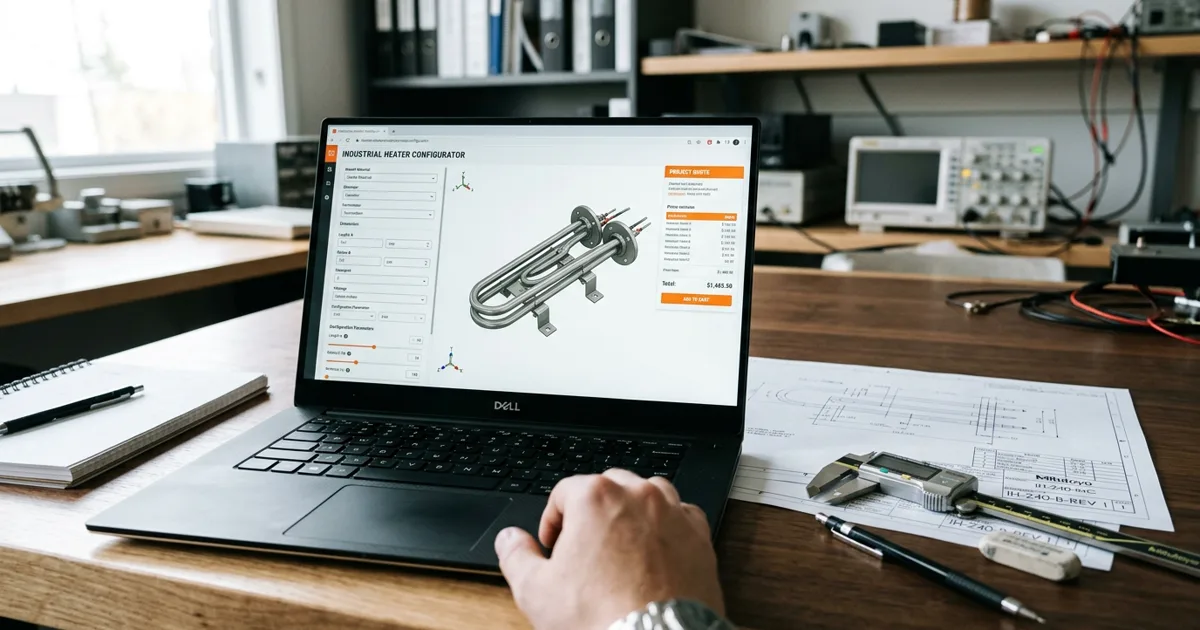
In most custom manufacturers, quoting lives in a spreadsheet that one or two people really understand. It works (the math is right, the margins are in there somewhere) until a quote takes three days because the engineer who owns the sheet is at a trade show. A web-based product configurator takes that same math and puts it behind a form anyone in sales can drive. On one of our projects, quote turnaround dropped 90%: from days to under an hour.
Why the Spreadsheet Stops Scaling
The quoting spreadsheet is usually excellent engineering. The problem is everything around it:
- It needs its author. The formulas encode constraints nobody wrote down: which combinations are buildable, when a design needs the thicker gauge, where the safety margins live. Sales can't safely drive it, so every quote queues behind engineering.
- Versions drift. Copies multiply across laptops. Someone quotes January prices in June from a stale copy. Nobody knows which version is right.
- It stops at the price. After the quote is accepted, someone still builds the BOM and routing by hand, re-deriving what the spreadsheet already computed and introducing a fresh chance of error.
- It can't say no. Spreadsheets compute anything you type. They don't tell a salesperson the geometry can't physically be manufactured. That gets caught in engineering review, days later, as a bounced quote.
What a Configurator Actually Is
A configurator is the spreadsheet's math, moved into a web application, with three additions the spreadsheet can't make: validation, visualization, and downstream outputs.
The same math, translated exactly
The heart of the build is translating the engineering calculations formula by formula: resistance from voltage and wattage, developed length from geometry, wire gauge selection, watt density limits. This translation is careful, unglamorous work, and it is where the project succeeds or fails. The configurator must agree with the spreadsheet to the rounding digit on the products already quoted, and we test it against a library of past quotes before anything goes live.
Validation that says no early
The rules that lived in the engineer's head become live checks: a watt density over the limit for the sheath material flags red before the quote exists, not in review two days later. Marginal designs get a warning and an explanation. Sales learns the product's boundaries by using the tool.
The picture
A live drawing or 3D model rebuilding as options change does two jobs: customers confirm "that's what I meant" before anything is built, and dimension mistakes become visible instead of numeric. On our 3D configurator project, the model is generated from the same geometry that drives the pricing, so the picture can't disagree with the quote.
Outputs the back office can use
The configuration that priced the quote generates the spec sheet PDF, the BOM, and the manufacturing routing from the same data. Setup time amortizes across the ordered quantity, so volume price breaks are re-costed, not flat-discounted: the qty-500 price is a real cost roll-up, not a marketing number. When the order lands, production paperwork exists already.
What It Costs and When It's Worth It
A configurator for one product family (form, validation, live pricing, PDF output) typically runs $20,000-$50,000 and takes 6-10 weeks. Adding 2D/3D visualization, multi-product catalogs, ERP hand-off, or customer-facing self-service raises both. The economics work when quoting is a bottleneck you can measure: if engineering touches 20+ quotes a week at 30-60 minutes each, the labor alone covers the build inside a year, before counting the quotes you currently lose to slow turnaround.
That last number deserves attention. In competitive custom work, the first credible quote often wins. A configurator doesn't just make quoting cheaper; it makes your quote the one that arrived while the competitor's was still in the engineering queue.
When Not to Build One
If your quoting is mostly standard catalog items at list price, you need a price list, not a configurator. If every job is genuinely novel engineering with no repeating structure, a configurator can't capture it and a good estimator remains the tool. Configurators earn their keep in the middle: products with real engineering variability that follows rules: dimensions, materials, options, constraints. If your engineer can explain how they'd quote something, that explanation is the spec.
Uptimize Solutions builds product configurators for custom manufacturers: engineering calculations, live validation, 3D previews, and BOM generation from a single model. If your quoting queue runs through one spreadsheet and one engineer, see our custom app work or book a free workflow audit and bring a recent quote, and we'll walk through what it would look like in a configurator.