
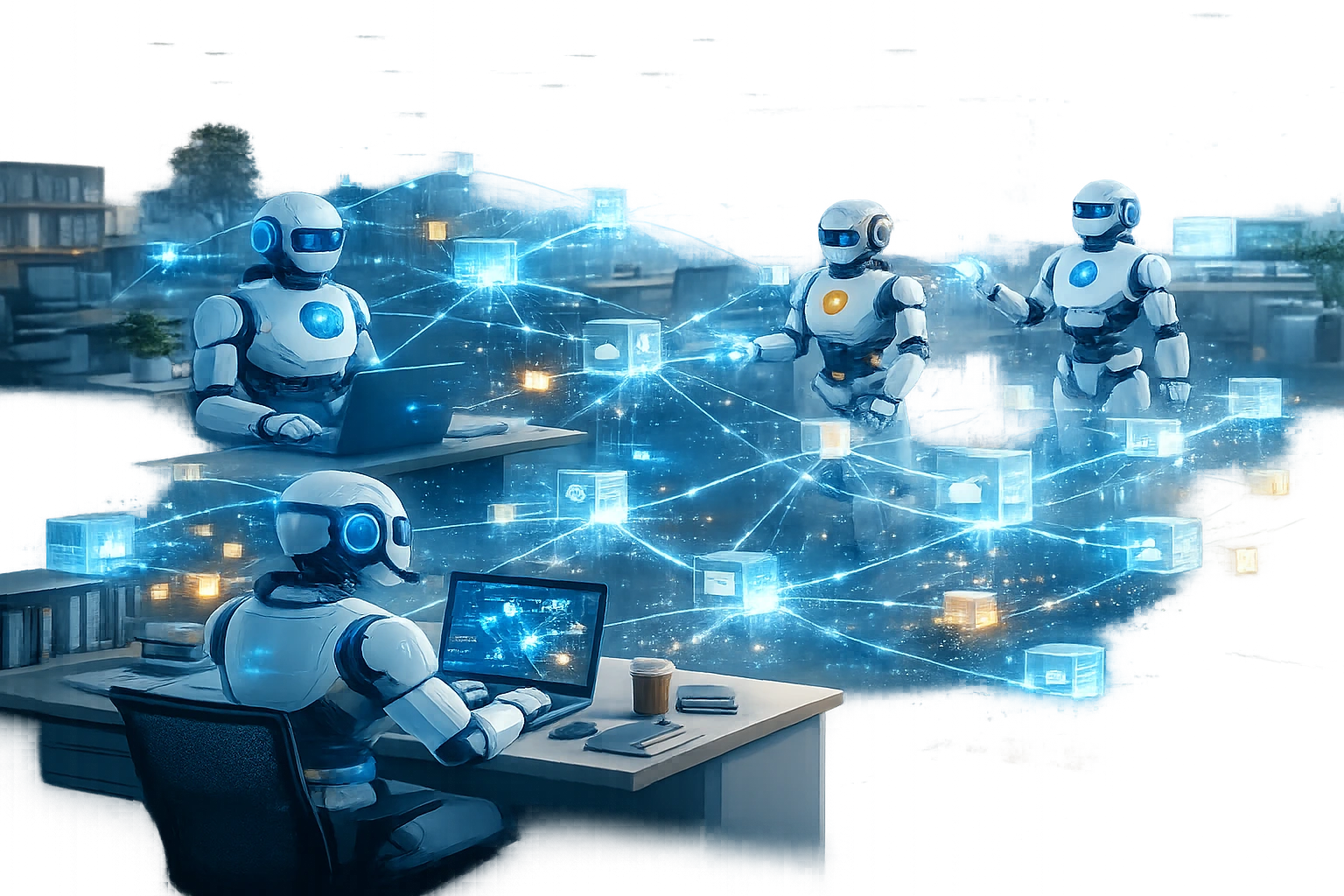
Something significant is happening in offices and warehouses across the country. Artificial intelligence is no longer just answering questions or generating text. It's making decisions, taking actions, and managing workflows with minimal human oversight.
The term "AI agent" gets thrown around a lot, often imprecisely. An AI agent is software that can perceive its environment, make decisions, and take actions to achieve specific goals. Unlike traditional automation, which follows rigid scripts, agents can adapt to new situations, learn from outcomes, and handle tasks that would typically require human judgment.
Think of the difference between a thermostat and a skilled building manager. The thermostat follows simple rules: if the temperature drops below 68, turn on the heat. The building manager considers occupancy patterns, weather forecasts, energy costs, and maintenance schedules. AI agents operate more like the building manager, weighing multiple factors and adjusting their approach based on results.
From Chatbots to Autonomous Workers
The progression has been remarkably swift. Just two years ago, most businesses were experimenting with chatbots that could answer basic customer questions. Today, those same companies are deploying agents that research potential vendors, compare pricing, and draft initial contract proposals. They monitor inventory levels, predict demand shifts, and automatically adjust orders. They analyze customer complaints, identify root causes, and implement solutions. They schedule meetings, prepare briefing documents, and follow up on action items. They review code, identify bugs, and suggest fixes before human developers see them.
The key distinction is autonomy. These agents don't wait for instructions. They identify what needs to be done and do it.
Why Now?
Several factors have converged to make AI agents practical for mainstream business use.
The foundation models powering these agents have improved dramatically in their ability to reason, plan, and follow complex instructions. They can now break down ambiguous goals into concrete steps, anticipate potential problems, and adjust when things go wrong.
Tool integration has matured. Modern agents can connect to dozens of business systems: CRMs, ERPs, email platforms, databases, and APIs. This connectivity allows them to gather information, take actions, and verify results across the entire business technology stack.
And costs have dropped. Running sophisticated AI models has become significantly cheaper. Tasks that would have cost hundreds of dollars in compute time two years ago now cost pennies. This makes it economically viable to deploy agents for routine work.
Real Applications in Real Businesses
A regional insurance company recently deployed an agent to handle policy renewals. The agent reviews each upcoming renewal, checks the customer's claim history, evaluates competitive pricing, and prepares personalized retention offers. For straightforward cases, it processes the renewal automatically. For complex situations, it prepares a summary and recommended action for a human underwriter. The company reports that the agent now handles 73% of renewals without human intervention, while customer retention has actually improved.
A mid-size manufacturer uses agents to manage its supplier relationships. The agents monitor delivery performance, track quality metrics, identify emerging risks like financial instability or geopolitical issues, and flag problems before they affect production. When issues arise, the agents can negotiate with suppliers, find alternative sources, and adjust production schedules accordingly.
Accounting departments are finding that agents excel at the investigative work that consumes so much staff time. Matching invoices to purchase orders, chasing down discrepancies, reconciling accounts, and preparing audit documentation are all tasks that agents can handle competently. One CFO described it as "finally having enough staff to do the job properly."
The Human Element
None of this means humans are becoming obsolete. The most effective deployments treat agents as capable team members who still need supervision, not as replacements for human judgment.
Consider how a law firm might use an AI agent for due diligence on an acquisition. The agent can review thousands of contracts, flag potential issues, and organize findings into a coherent report. But the partner still needs to interpret those findings, advise the client on risk tolerance, and negotiate terms. The agent handles the tedious work. The human handles the work that requires wisdom.
This pattern repeats across industries. Agents excel at tasks that are time-consuming but not conceptually difficult, repetitive with slight variations, information-intensive, and rule-based with occasional exceptions. Humans remain essential for genuine creativity, complex ethical judgments, relationship building, strategic vision, and accountability for high-stakes decisions.
Getting Started With Agents
For businesses considering AI agents, the path forward requires careful planning.
The most successful implementations begin with a specific pain point, not a general desire to "use AI." Look for processes that are clearly documented, have measurable outcomes, and currently consume significant staff time.
Even the best agents make mistakes. Start with low-stakes tasks where errors are easy to catch and correct. As the agent proves reliable, expand its authority incrementally. Build in checkpoints where humans can review decisions before they become final. Create clear escalation paths for situations that exceed the agent's capabilities.
And remember that agents are only as effective as the systems they can access. Evaluate your current technology stack and address integration gaps before deployment.
What Comes Next
The technology is advancing rapidly. Within the next year, we expect to see agents that can collaborate with each other, dividing complex projects into subtasks. They'll have improved ability to learn from feedback and mistakes, better handling of ambiguous instructions and edge cases, and more sophisticated reasoning about long-term consequences.
For business leaders, the question is no longer whether AI agents will affect their operations. It's how quickly they can deploy agents effectively while managing the associated risks.
The companies that get this right will find themselves with a significant competitive advantage: the ability to operate at higher quality and lower cost than rivals who are still doing everything the old way.
Uptimize Solutions helps businesses identify high-value opportunities for AI agent deployment and build the infrastructure needed to support them. If you're curious about what autonomous AI could do for your operations, let's talk.