
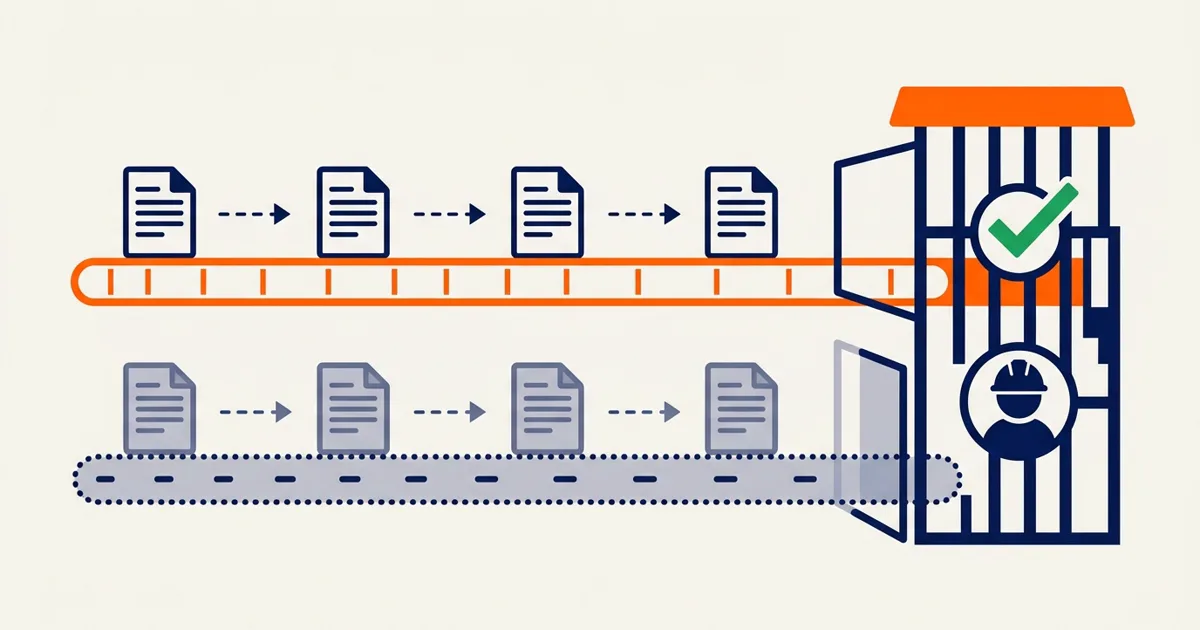
The riskiest day of any automation project is the day it goes live, unless the rollout is designed so that day never really exists. The pattern we use on every order and invoice automation we ship is the same: run in shadow, review everything, then let the system earn autonomy one category at a time. It sounds slower than flipping the switch. It's faster, because it's the only version where trust survives the first mistake.
Why Big-Bang Go-Lives Fail Even When the Software Works
Automation projects rarely die of bad code. They die of broken trust. One wrong order shipped in week one and the whole team quietly resumes checking everything by hand. Now you're paying for the automation and the manual process it was meant to replace, indefinitely. The math is unforgiving: a system that's 97% right, deployed all at once, introduces its 3% of errors at full volume, in production, in front of everyone, before anyone has a feel for which 3% to watch.
The fix isn't better software. It's a rollout shaped like evidence-gathering.
Stage 1: Shadow Mode (the System Works, Nothing Happens)
In shadow mode, the automation does its full job (reads the documents, matches the POs, drafts the orders) and none of it takes effect. People keep working exactly as before. Every day, the system's output sits next to what the humans actually did, and the differences get examined.
This stage answers the question no demo can: how does it do on our real inputs? Your ugliest vendor invoices, your customer who faxes photos of POs, your part numbers with the legacy prefixes. Two to four weeks of shadow running typically surfaces a punch list of fixes (a date format nobody anticipated, a customer whose POs put the ship-to in the footer), each found at zero cost, because nothing the system got wrong ever left the building.
Shadow mode has a second, underrated product: a baseline. You learn your humans' actual error rate too, which is rarely zero and makes the later comparison honest.
Stage 2: Review Mode (the System Acts, People Approve)
Next, the automation's output becomes real work product, but every item passes a person before it takes effect. The order posts when someone clicks approve; the invoice goes out when someone releases it. The review screen shows the evidence beside each decision (the pattern we've written about before), so approval takes seconds for clean items.
Two disciplines make this stage count:
- Track approval rates by category, not overall. "94% approved untouched" hides the story; "99% on typed distributor POs, 71% on emailed body-text orders" is a rollout map. It tells you exactly what can graduate to autonomy and what needs work.
- Treat every correction as a bug report. A reviewer fixing the same thing twice is the system telling you where its next rule comes from. The corrections feed translation tables, matching rules, and validation, which is why approval rates climb for months.
Stage 3: Earned Autonomy, Category by Category
Autonomy is granted per category, on evidence, and the boundary is enforced by the software. When typed POs from your top 20 accounts have run 99%+ clean for six weeks, those flow straight through; everything else still queues for review. Over months, the autonomous share grows (60%, then 75%, then 85%) and the review queue shrinks to genuine exceptions.
Three rules keep this stage safe:
- Guardrails don't graduate. Duplicate detection, price-variance limits, refuse-to-double-bill checks: these run on every item forever, autonomous or not. Autonomy skips the human glance, never the validation.
- New anything starts in review. New customer, new document format, new channel: first contact always goes through a person, regardless of how mature the system is. Novelty is where confidence scores are least trustworthy.
- Demotion is one switch. If a category starts misbehaving (a customer redesigned their PO template), it drops back to review instantly, without a deploy. The ability to retreat cheaply is what makes advancing feel safe.
What the Timeline Really Looks Like
For a typical order or AP automation: two to four weeks of shadow, four to eight weeks of full review, then a long tail of category-by-category graduation. Meaningful labor savings start in the review stage (approving is much faster than keying), so the payback clock starts around week four, not at "full automation," which is a horizon you approach rather than a date you announce. Our 85% AP automation reached its number this way: the last categories earned autonomy months after the first ones.
The pattern generalizes past AI. Any system that takes actions with money attached (integrations that post transactions, sync jobs that update prices) deserves the same ladder: observe, approve, then trust, with the evidence written down. Flipping the switch is a bet. This is a measurement.
Uptimize Solutions ships automation on this rollout pattern by default (shadow, review, earned autonomy) for order intake, AP, and ERP integrations. If a past go-live burned your team's trust in automation, see how we deploy differently or book a free workflow audit and we'll sketch the staged plan for your workflow.