
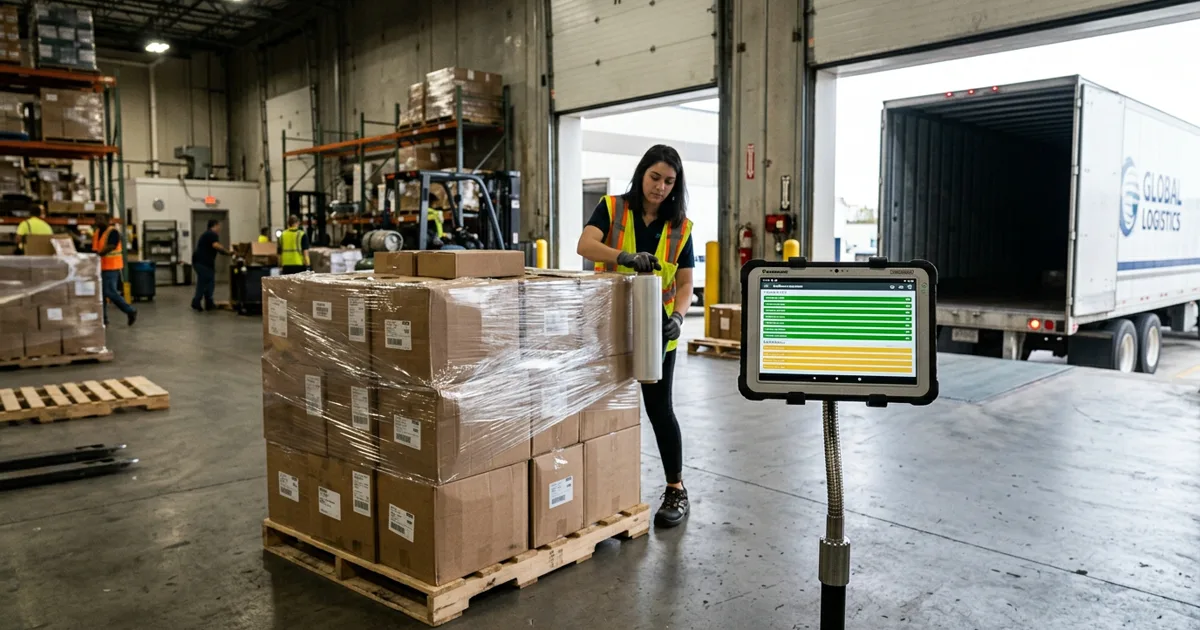
An order for 100 chairs ships 60 on the first truck. The remaining 40 come three weeks later, on a truck with other customers' freight. Somewhere in between, someone invoices. This is the moment most order systems quietly get wrong. Because the errors are quiet, they surface as customer disputes, double payments, and month-end mysteries rather than error messages. Having built fulfillment and invoicing automation that handles thousands of these splits, here are the rules that keep the money right.
Why Partials Break Systems
Most order workflows are designed around a fiction: one order, one shipment, one invoice. Reality at any distributor or make-to-order manufacturer is messier: three or four shipments against one PO is routine. When the system's model doesn't match, people improvise, and every improvisation is a chance to bill wrong:
- Invoice the whole order on the first truck, and you've billed the customer for 40 chairs they don't have. Their AP will short-pay, and now the dispute costs more than the chairs.
- Invoice quantities by hand off the packing list, and eventually someone bills line 3 twice across two invoices, or misses it entirely.
- Charge freight per invoice, and a three-shipment order gets three freight charges when the customer agreed to one.
The Rules That Keep It Honest
Bill the delta, never the order
The only safe invoicing question is: what has shipped that has not yet been billed? Each invoice covers exactly that delta: shipped across all trucks so far, minus what earlier invoices already charged, line by line. Invoice #2 for the backordered 40 chairs cannot re-bill the first 60, because the math starts from what invoice #1 already covered. This has to be computed from shipment history, not from order status. "Status = shipped, invoice flag = no" is how systems bill a review-stage order in full; quantities don't lie.
One place computes what's billable
Every path that creates an invoice (the button a person clicks, the automation that fires when a truck is marked shipped) must run through the same billing logic. The moment two code paths each compute "what to bill," they drift, and the drift is a wrong invoice. Same rule for freight: one function owns the freight amount, and it bills once per order (on the first invoice), no matter how many shipments follow.
Refuse to double-bill, structurally
The system should make the wrong action impossible, not discouraged: if nothing has shipped, invoice creation refuses. If every shipped unit is already billed, it refuses, because clicking "Generate Invoice" twice is not a rare accident, it's a Tuesday. A refusal with a clear reason beats a duplicate invoice and an awkward credit memo every time.
Backorders are a quantity, not a status
What's owed to the customer is the per-line remainder: ordered, minus shipped across all trucks. That remainder is what returns to the pick queue for the next truck, at the remaining quantity, not the original one. And "backordered" shouldn't be a stage that replaces other stages: an order can be partially shipped, partially invoiced, and still owing stock all at once. Systems that force one status per order make those states invisible, and invisible owed stock is how the last 40 chairs get forgotten until the customer calls.
History is load-bearing
Which units went on which truck, which invoice billed them, what the BOL said when the driver signed it: these are records of physical and financial events. Nothing may rewrite them. A practical corollary from our own work: when an order predates detailed line history, the safe assumption is that it was fulfilled as recorded, not that everything is still owed: the optimistic reading resurrects long-shipped orders into the pick queue to be shipped and billed twice. We caught exactly that on real data.
What Good Looks Like Day to Day
When the rules above are in place, the daily experience is boring in the best way. The warehouse sees a ready pool that already knows what's owed per line. Loading a truck short doesn't require a decision about paperwork: the system records what left, offers the invoice for exactly that, and returns the rest to the pool. The controller sees invoices that always reconcile to shipments. The backordered queue is a real list with dollar values, not a folklore of sticky notes. And when a customer calls about invoice #2, the answer traces to specific units on a specific truck with a signed BOL attached.
None of this requires exotic software. It requires the order-to-cash flow to be modeled the way freight actually moves, in pieces, and the billing math to be written once, tested against the ugly cases, and shared by every path that can create an invoice. If your team has a standing rule like "never invoice until the whole order ships" or "check the last invoice before generating a new one," that rule is compensating for a system that doesn't know these things. The rule works until the day someone's covering a vacation.
Uptimize Solutions builds order-to-cash automation for manufacturers and distributors: fulfillment tracking, shipment-based invoicing, and the ERP integration underneath. If partial shipments mean hand-checked invoices at your company, see our integration services or book a free workflow audit and bring your ugliest split-shipment story. We collect them.