
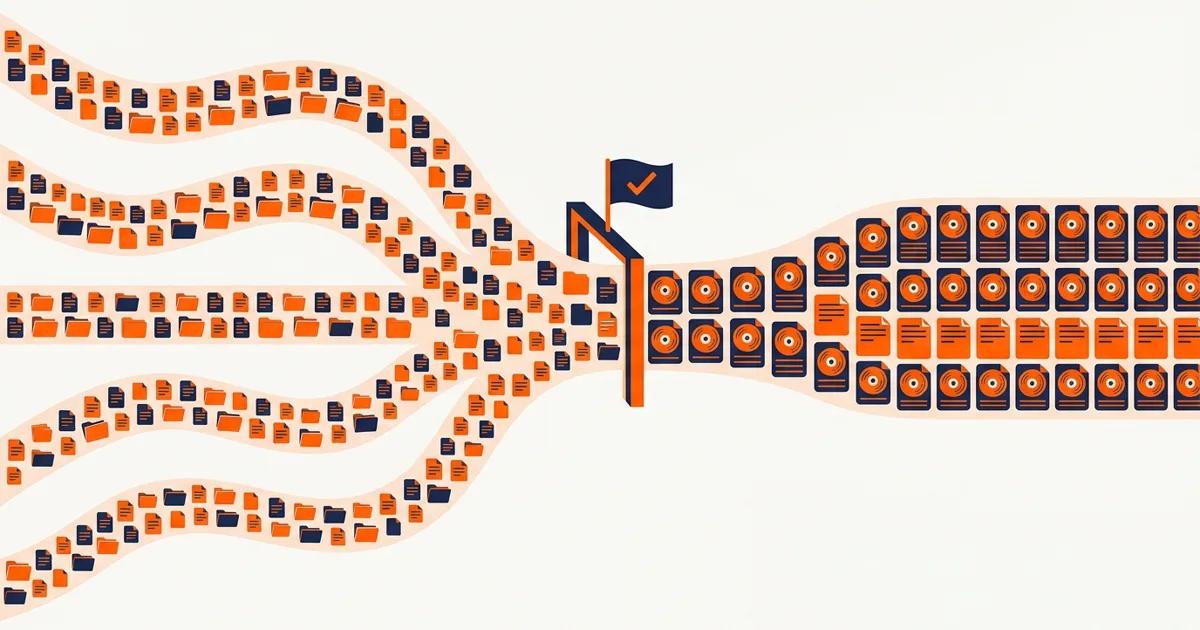
The acquisitions made strategic sense. Then the integration team went home, and operations inherited the aftermath: five ERPs, five customer lists with the same customers spelled five ways, five part numbering schemes, and a CFO who needs three analysts and two weeks to answer "what did we sell last quarter?" We've done this consolidation: five acquired companies onto one system, where 34% of customer records turned out to be duplicates. This article is the sequence that worked, including the parts that only became obvious mid-project.
Why Post-Acquisition Data Is Its Own Problem
This isn't ordinary data cleanup at larger scale. Acquired companies overlap in ways a single company never does: they sold to the same customers (each with its own account numbers, pricing, and terms for the same buyer), stocked the same products under different SKUs, and ran different fiscal calendars, units of measure, and definitions of basic words like "order." The duplicates aren't accidents of sloppy entry; they're five legitimate histories that were never supposed to meet. That changes the work: you're not deleting bad records, you're merging true ones, and every merge decision has money attached.
The Sequence: Audit, Map, Dedupe, Validate, Migrate
1. Audit before promising anything
Before dates get committed, inventory what actually exists in each system: record counts, active versus dead, data quality by table, and the customizations each company bolted on. Every consolidation we've seen slip its schedule slipped here: someone assumed five similar distributors would have five similar databases. They never do. The audit takes two or three weeks and rewrites the plan every time.
2. Map to a canonical model
Pick the target model (usually the surviving ERP's) and map every source system into it. The hard decisions are definitional, not technical: which company's customer terms win when the same buyer has three? Whose part numbering becomes the standard? These are business calls, and the project needs a named decision-maker with authority to make them in days, not committees that make them in quarters. Write the decisions down; the migration scripts are just the decisions, executed.
3. Deduplicate with humans on the hard cases
Fuzzy matching on normalized names and addresses generates candidate matches; software auto-merges the certain ones and queues the uncertain for review. In our five-company project, that review pile was where the 34% figure emerged: a third of the combined customer base was the same companies wearing different spellings. Two rules kept it safe: a wrong merge is worse than a missed one (unmerged duplicates annoy; wrong merges corrupt credit exposure and sales history), and every merge keeps a cross-reference, because a year later someone will ask where account 4471 from Company C went, and "it's in the new system somewhere" is not an answer that survives an audit.
4. Validate with control totals and real people
Same discipline as any migration, multiplied by five: control totals per source company (customer counts, open AR, inventory value, explained line by line, not "close enough"), traced sample transactions, and an hour with each company's AR and customer service people looking at their own converted accounts. The acquired companies' staff are the only ones who know their data's folklore; skipping them to save schedule discovers the folklore in production.
5. Migrate in waves, not a weekend
One company at a time onto the consolidated system, with a few weeks between waves to absorb lessons. The first wave takes longest and teaches the most; the fifth is routine. Big-bang cutovers of five companies at once concentrate every unknown into one weekend. We've been called in after two of those, and the cleanup cost more than a waved migration would have.
What You Get on the Other Side
The consolidation pays in the same currencies the chaos was costing: one customer list, so credit exposure and sales history are finally whole numbers; one item master, so purchasing consolidates volume it was splitting across five vendor relationships; and reporting that answers the CFO's question in minutes: the dashboards that were impossible against five systems become straightforward against one. In our project, month-end close shortened by five days once the consolidation settled.
If there's another acquisition coming (there usually is), the canonical model and the merge tooling become reusable. The sixth company onboards in weeks using the machinery built for the first five. That's worth designing for from the start: treat the consolidation not as a one-time cleanup but as building the intake process for a company that intends to keep acquiring.
Uptimize Solutions consolidates post-acquisition systems for manufacturers and distributors, from audit through waved migration, with the merge decisions documented. If your company is three acquisitions deep and one source of truth short, see our consolidation services or book a free workflow audit and we'll scope the audit phase.