
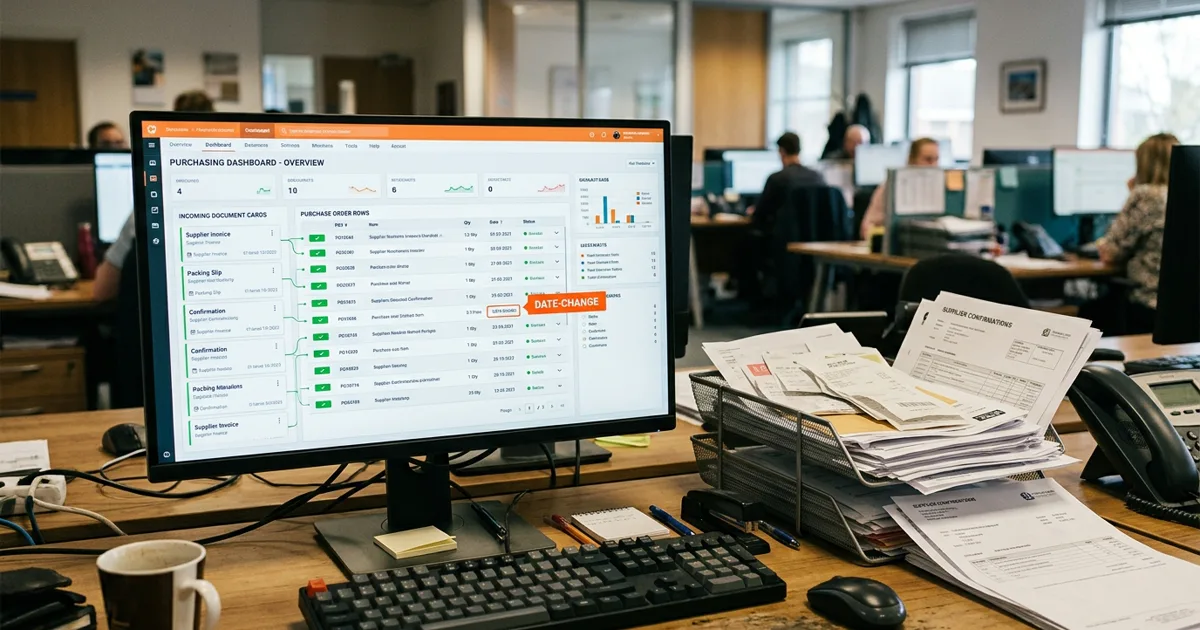
For every purchase order your company sends, the supplier sends paper back: an order confirmation, maybe a revised one, a ship notice, an invoice. At a manufacturer cutting 100 POs a week, that's several hundred inbound documents a month, each answering questions someone cares about: did they accept our price? did the date slip? did they short the line? Almost everywhere, the answers live in an inbox, extracted one email at a time by buyers who have better things to do. We've been building AI capture for exactly this flow, and it's quietly become one of the highest-leverage automations in purchasing.
The Cost Hides in the Misses, Not the Reading
The reading time is real: a buyer reconciling confirmations against open POs loses an hour or two a day to it. But the expensive part is what slips through when the reading gets rushed:
- The moved date nobody caught. A confirmation quietly pushes delivery two weeks. Nobody updates the PO, planning keeps promising customers off the old date, and the stockout arrives with no warning. This is the single most common miss, because date changes hide in paragraph three of a confirmation that otherwise matches.
- The price that grew. Confirmation says $14.80 against a PO at $13.90. Unnoticed, it becomes an invoice discrepancy months later, fought after the goods arrived, which is the weakest possible negotiating position.
- The silent partial. Confirmed quantity is 400 against an ordered 500, and the shortfall surfaces at the receiving dock, when the production schedule that assumed 500 is already committed.
- The document nobody can find. Six months later a dispute needs the confirmation as sent. It's in someone's mailbox, or their predecessor's.
What the Capture Pipeline Does
The pattern mirrors the order-intake and AP automation we've written about, pointed at the other side of the business:
Reads whatever the supplier sends
A watched mailbox ingests the PDFs, spreadsheets, and body-text emails. AI extraction pulls the PO reference, line items, quantities, prices, and promised dates, and every extracted value keeps its link to the exact spot on the document it came from, the same evidence pattern that makes review fast enough to trust.
Matches against the open PO, line by line
This comparison is the entire point. A confirmation isn't information in a vacuum; it's a response to a specific PO, and the system diffs them: price against price, quantity against quantity, promised date against required date. Clean matches (most of them) confirm silently and update the PO's status. Deviations become flagged, structured exceptions: "line 2: confirmed 400 of 500," "delivery moved May 12 to May 26."
Routes the exceptions to a decision, not an inbox
A date slip that breaks a customer promise needs a buyer's judgment: expedite, source elsewhere, or renegotiate the customer date. The system's job is making that decision arrive pre-assembled: the deviation, the affected downstream orders, the document evidence, one screen. What used to be discovered at the receiving dock gets decided the morning the confirmation arrives.
Archives the original, permanently
Every captured document lands in a durable archive tied to the PO. It keeps the original bytes, not a mailbox reference, for the same reason shipping documents should archive themselves: the moment anyone needs the confirmation as sent is a dispute, months later, when inbox archaeology fails. If your company runs on SharePoint or a document system, the archive can mirror there automatically, so the paper trail lives where the rest of the project files already do.
What Changes for the Purchasing Team
Confirmations stop being reading work and become a short exception queue. PO statuses in the ERP stay current without anyone typing, which means planning runs on promised dates that are actually the supplier's latest word. Price discrepancies get fought before shipment instead of after invoice. And supplier scorecards get real data: confirmed-versus-actual dates accumulate automatically, so "they always slip" turns into "they slipped 9 of the last 20 POs by an average of 8 days," which is a very different conversation to have at contract renewal.
The rollout follows the same staged pattern as everything else we deploy: shadow first, then review-and-approve, then earned autonomy for the clean-match majority. Purchasing teams tend to trust it faster than AP teams did: a confirmation that matches its PO is a low-stakes update, and the high-stakes items were exactly the ones the old process was missing.
Uptimize Solutions builds document capture for both sides of the order flow: customer POs in, supplier confirmations and invoices back. If your buyers spend afternoons reading email against open POs, see our AI workflow automation or book a free workflow audit and bring last month's worst date slip. We'll show you where the system would have caught it.