
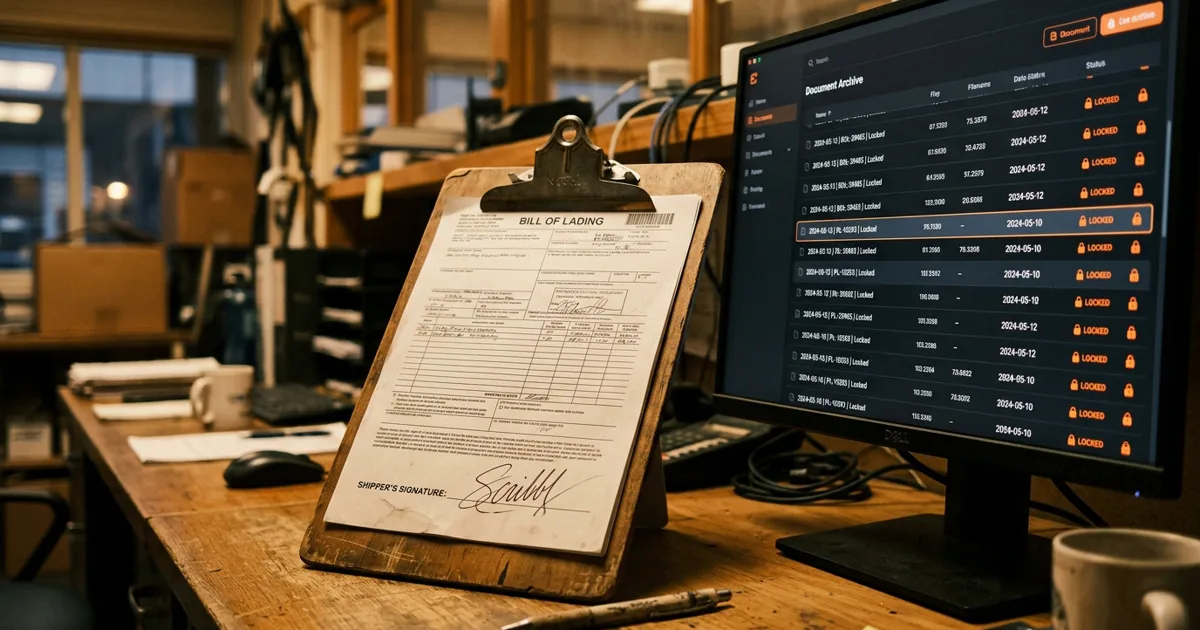
A customer disputes a delivery from last November. The freight bill says three pallets; the customer says two arrived. The document that settles this is the proof of delivery with the receiver's signature. If you can produce it. Whether you can turns out to depend on two design decisions most companies never consciously made. Both usually go wrong, quietly, and both are cheap to fix once you see them.
Failure One: The Reprint That Isn't the Document
In most order systems, printing a bill of lading means rendering it: the system pulls today's order data and formats it onto the BOL template. That's fine on shipping day. It fails in a specific, sneaky way afterward: print the BOL, load the truck, and next week correct a quantity on the order. Now reprint that BOL for the file. The reprint shows the corrected quantity: it differs from the paper the driver signed.
A BOL is not a view over current data. It's a record of what physically left the dock, on a date, under a signature. When a reprint can differ from the signed original, your "documentation" is whichever version someone happens to print, and in a dispute that's worse than no documentation: it's documentation that contradicts itself.
The fix is an old accounting idea applied to paperwork: documents are immutable records, not reports. When a BOL or packing list is generated, the rendered document itself gets stored: bytes, not a reference to live data. A later correction produces a new document version alongside the original, never over it. "Which BOL went with the truck" stays answerable forever, because the answer is a stored file, not a re-computation.
Failure Two: The POD You Have Is a Link That Died
Carrier and TMS APIs generally return documents (PODs, signed BOLs, weight certificates) as short-lived signed URLs, not files. The link works today. It stops resolving in days or weeks, by design.
Store that URL in your shipment record and you'll pass every test on shipping week: click, document opens, done. The failure surfaces months later, which is precisely when PODs get requested: freight disputes, short-pay claims, and chargebacks don't happen at delivery time. The moment someone finally needs the POD is the moment the link 404s. You "had" the document the way you have a coat you left on a train.
The fix: when the carrier makes a document available, fetch the bytes immediately and archive them in your own store, attached to the shipment. And because carriers' document feeds are best-effort, the fetch must be too: a POD that can't be retrieved right now should log and retry, never block the shipment workflow that triggered it. A missing POD is a problem; a truck held hostage by a document fetch is a bigger one.
What a Self-Archiving Document Flow Looks Like
Put together, the pattern is small enough to describe in a paragraph. Every document the system generates (BOL, packing list, order copy, invoice) is archived as rendered, at generation time, immutably versioned. Every document a carrier produces is fetched as bytes when its link appears and archived against the shipment. Everything is indexed by order, shipment, and date, so "pull the paperwork for PO 88412" is one query returning the originals. Nothing in the archive can be overwritten. Corrections append.
The payoffs stack up in ordinary weeks, not just disputes:
- Disputes resolve in minutes. The signed POD attaches to the email; the short-pay claim dies. One recovered chargeback typically pays for the archive.
- Audits stop being archaeology. The paper trail for any shipment is complete and in one place, instead of split across a filing cabinet, a carrier portal login, and someone's email.
- Reprints are honest. The office can reprint the floor's copy of anything, and it's the copy, not a fresh rendering that silently drifted.
Why This Gets Skipped
Document archiving loses the priority fight because its absence costs nothing for months at a time. Everything works until the first real dispute, which arrives with money attached and a deadline. By then the PODs from last winter are dead links and the BOL history is whatever the current data renders. If you're already integrating with your carriers, the archive is a modest addition to work you're doing anyway; the retrieval calls and the storage are the easy parts. What matters is deciding, once, that documents are records, and letting the system enforce what the filing cabinet used to.
Uptimize Solutions builds shipping and document automation for manufacturers and distributors: carrier integration, BOL and packing list generation, and archives that keep what the driver actually signed. See our integration services or book a free workflow audit. And if you want a quick self-test, try to pull the signed POD for a shipment from six months ago.